
On this pageTap to expand
Abbas Kiarostami stands as a towering figure in the landscape of world cinema, a director whose work transcended national boundaries to influence filmmakers and cinephiles alike. Born in Tehran in 1940, Kiarostami’s career spanned nearly five decades, during which he forged a cinematic language that was at once minimalist and rich with philosophical inquiry.
His films delve deeply into the human condition, creating narratives that blur fiction and documentary, reality and imagination, challenging audiences to engage actively with the medium.

Unlike many directors who rely on spectacle or elaborate plot structures, Kiarostami embraced simplicity as a gateway to complexity. His visual compositions often feature long takes, sparse dialogue, and naturalistic performances that invite reflection rather than immediate emotional gratification.
This approach aligns him with other auteurs known for their contemplative style, yet Kiarostami’s work is distinctly rooted in the cultural and social fabric of Iran, even as it explores universal themes.
Internationally celebrated and frequently cited among the most influential filmmakers of his generation, Kiarostami’s oeuvre includes some of the most essential films of modern cinema. Whether exploring childhood innocence in Where Is the Friend’s House? or existential despair in Taste of Cherry, his films maintain a quiet but persistent interrogation of life’s mysteries.
The Films That Best Represent His Style
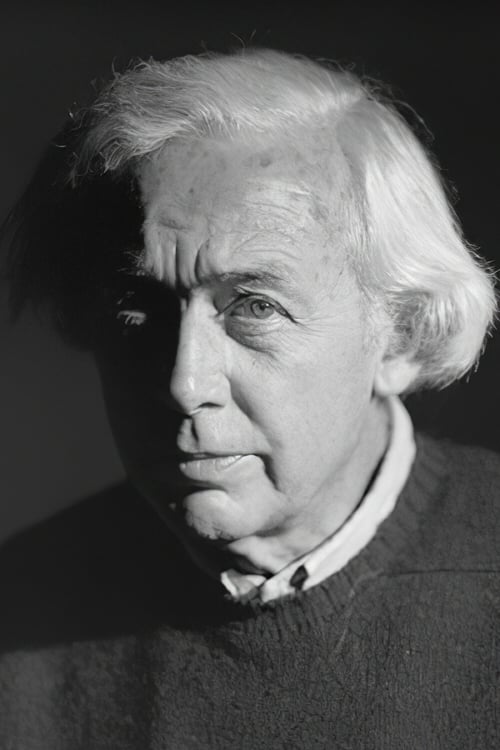
Cinema quote“Cinema, radio, television, magazines are a school of inattention: people look without seeing, listen in without hearing”
Robert Bresson

Any attempt to understand Abbas Kiarostami’s signature style begins with his masterworks that exemplify his minimalism and philosophical depth.
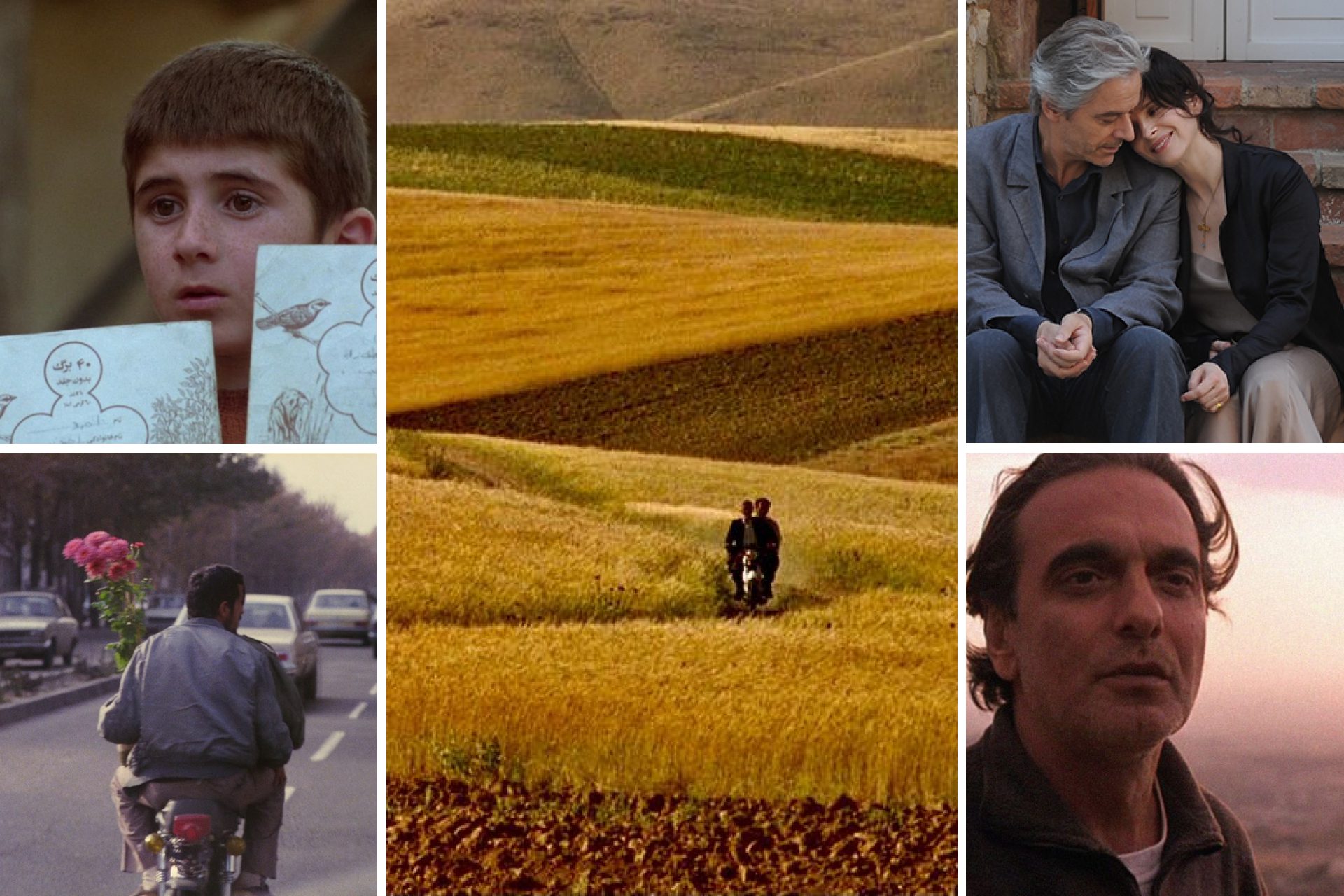
- Where Is the Friend’s House? (1987) – This early feature is deceptively simple: a young boy’s quest to return a notebook to his classmate. Yet beneath the innocence lies a profound meditation on responsibility and community.
- Close-Up (1990) – Part documentary, part fiction, this film blurs boundaries as it recounts a real-life incident involving a man who impersonated filmmaker Mohsen Makhmalbaf. It is a meta-cinematic exploration of identity, truth, and storytelling.
- Taste of Cherry (1997) – Perhaps Kiarostami’s most internationally renowned work, it follows a man searching for someone to bury him after he commits suicide. The film’s slow pacing, sparse dialogue, and open-ended conclusion exemplify Kiarostami’s philosophical minimalism.
- The Wind Will Carry Us (1999) – A lyrical exploration of life and death in a Kurdish village, this film balances poetic imagery with moments of quiet humor and human warmth.
- Certified Copy (2010) – Marking a geographical and stylistic shift, this film set in Tuscany stars Juliette Binoche and delves into the nature of authenticity and relationships, maintaining Kiarostami’s interest in blurred realities.
Other significant films such as Like Someone in Love (2012) and Ten (2002) continue his engagement with identity and perception, often using unconventional narrative structures and intimate settings.
Filmmaker quote“I want to create the type of cinema that shows by not showing. This is very different from most movies nowadays, which are not literally pornographic but are in essence pornographic, because they show so much that they take away any possibility of imagining things for ourselves. My aim is to give the chance to create as much as possible in our minds, through creativity and imagination. I want to tap the hidden information that’s within yourself and that you probably didn’t even know existed inside you.”
Abbas Kiarostami

The Breakthrough Moment

Kiarostami’s breakthrough came with Where Is the Friend’s House?, which heralded his arrival on the international stage and established the foundations of what would become his distinctive style. The film’s modest narrative and use of nonprofessional actors were groundbreaking in Iranian cinema and laid the groundwork for his later, more stylistically daring works.
The international critical acclaim he garnered from this period set the stage for his later successes, particularly Close-Up and Taste of Cherry. The latter shared the Palme d’Or at Cannes in 1997 with Shohei Imamura’s The Eel, solidifying Kiarostami’s global reputation. This accolade was not so much an endpoint as a recognition of a filmmaker who had quietly but persistently reshaped arthouse cinema’s expectations.
Genre Patterns and Left Turns
Kiarostami’s films resist easy categorization, often blending genres and subverting conventions. Although his early work draws from neorealism, with its focus on social realities and nonprofessional actors, his films frequently veer into philosophical parables or poetic meditations.
Rather than adhering to genre norms, Kiarostami favored stories that unfold through everyday interactions and seemingly mundane events. Yet, within this simplicity lies a profound existential inquiry.
His films often explore themes of mortality, identity, and the fluidity of truth, making them as much philosophical essays as narratives.
Some of his later films, particularly Certified Copy, represent a geographical and stylistic shift, incorporating more formal theatricality and Western settings. These works maintain his thematic concerns but demonstrate his willingness to experiment with narrative form and cross-cultural dialogue.
Constraints That Shaped the Work
Working within the tightly controlled cultural environment of post-revolutionary Iran, Kiarostami faced significant restrictions that shaped both the content and form of his films. Censorship limited overt political commentary and representation of certain social issues, which propelled Kiarostami toward an elliptical storytelling style reliant on suggestion and ambiguity.
Technical and financial constraints also influenced his minimalist aesthetic. Using nonprofessional actors, shooting on location with natural light, and employing long, static takes were partly practical choices but became integral to his artistic signature.
This constraint-driven innovation resulted in films that feel intimate, immediate, and deeply authentic.
Moreover, Kiarostami’s background in graphic design and poetry encouraged a subtle visual and narrative economy. This multidisciplinary influence helped him craft films that move between image and text, silence and speech, reality and fiction.
Collaborators: Writers, DPs, Editors, Composers
Although Kiarostami often functioned as his own writer and editor, his collaborations were essential in refining his cinematic vision. Many of his films were co-written with close collaborators who contributed to the philosophical and narrative depth of his works.
- Bahman Kiarostami – Abbas’s son and frequent collaborator; he edited later features including Ten, Certified Copy, and Like Someone in Love.
- Farhad Saba – Cinematographer on key films such as Where Is the Friend’s House? and Through the Olive Trees, adept at capturing the simplicity and lyricism that define Kiarostami’s visuals.
- Peyman Yazdanian – Composer whose spare score for The Wind Will Carry Us supports the film’s contemplative mood without overwhelming the imagery.
- Jafar Panahi – A fellow Iranian filmmaker influenced by Kiarostami; he worked as assistant director on Through the Olive Trees before directing his own acclaimed features.
Kiarostami’s approach to collaboration was often fluid, preferring a small, trusted circle that understood the delicate balance between form and meaning in his films.
Early Life and Formative Influences

Born in Tehran in 1940, Abbas Kiarostami studied painting and graphic design at the University of Tehran before working in advertising and turning to filmmaking around 1970 at the Institute for the Intellectual Development of Children and Young Adults (Kanoon). His early exposure to visual arts and poetry profoundly influenced his cinematic aesthetic, fostering a sensitivity to composition, rhythm, and metaphor.
Kiarostami was deeply inspired by Italian neorealism, particularly the works of directors who emphasized everyday life and nonprofessional actors. He was also influenced by Iranian literary traditions and the philosophical inquiries embedded in Persian poetry and storytelling.

Internationally, his influences ranged from directors like Robert Bresson and Michelangelo Antonioni, who shared his penchant for restraint and existential themes, to the playful experimentation of Jean-Luc Godard. This diverse palette helped Kiarostami develop a unique cinematic language that bridged East and West.
Related on Filmmaking Lifestyle
Read next: Andras Kovacs: What It Teaches About Cinema, Billy Wilder: What It Teaches About Cinema, and Bimal Roy: What It Teaches About Cinema.
Wrapping Up
Abbas Kiarostami’s legacy is one of quiet revolution. His films do not shout or overwhelm but invite contemplation, asking viewers to look beneath the surface and engage with the profound questions of existence.
Through a minimalist aesthetic and a poetic sensibility, he expanded the horizons of Iranian cinema and influenced generations of filmmakers worldwide. He died in Paris in 2016; his final feature, 24 Frames, was completed and released posthumously.
His body of work—from Where Is the Friend’s House? to 24 Frames—remains a testament to the power of cinema as a medium for philosophical exploration and human connection. Kiarostami’s films endure not just as artistic achievements but as enduring meditations on life’s uncertainties and beauty.
Want to keep going with more cinema craft?


New comments are not currently accepted.
Comments