
On this pageTap to expand
Today, we’re going to cover the Vimeo embed feature and show you how to embed your videos on Vimeo.
One note before the click-path: Vimeo’s interface has moved since we first published this in 2021. Labels jump around. My Account, Settings, and Advanced may not sit where the screenshots below show them. Treat this as a job list, not a pixel-perfect tour of old menus: profile, clean URL, embed, who can watch and where, what happens when the film ends.
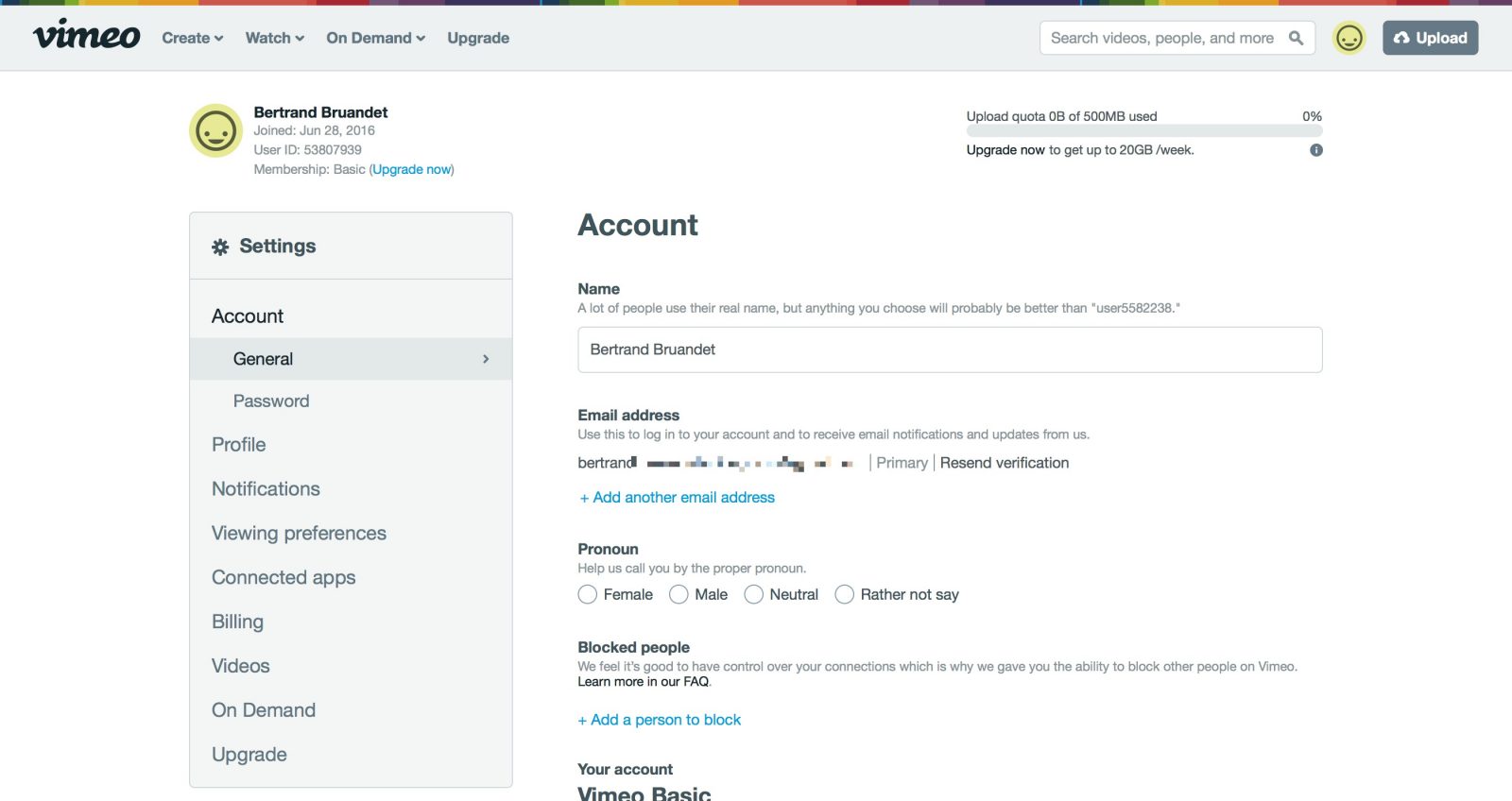
The Vimeo Profile
With the many settings options for the video, the own profile is often forgotten. But this too is important. It offers you a great opportunity to introduce your company.
Go to your account area and open the profile. In 2021 that path was My Account and then My Profile. If those words have moved, look for the place where Vimeo lets you edit the public face of the account — the name, the bio, the avatar.
Here you should upload a company logo or product logo and create a short description text in which you introduce yourself, your company, and your products. Also an opportunity to link your own website again.
Clients do not only watch the embed. They click through and decide whether you are a company or a hobby. A logo, a real sentence, and a site link do that work. If you are starting a video production business, do this before you send the first review link.

Individual Settings Options For Your Videos
At Vimeo, you have a lot of setting options, which I still miss with the known competitor.
The job here is a readable, ownable URL for the film. In the 2021 layout you clicked Settings, then Advanced, then Custom URL. Today, open the video and look for a custom URL, vanity URL, or link field — wherever Vimeo now lets you replace the default numeric address with words.

Deliver films clients rave about
Expectation-setting, music notes, and revision etiquette tailored to wedding clients — pulled into one readable guide.
If you know something about search engine optimization, you know how important the URL is.
Use an important tag for the URL. This is the theme of your video as well as the company name.
A good URL ensures that the video is more easily found by search engines and thus also by the user.
Write it like a slug, not a sentence — something you can paste into a proposal. Then leave it alone. Changing a public URL later breaks old embeds and old emails.
While you are in the video’s settings, set the title, description, and thumbnail as if this page might be the only page the client ever sees.
Embed Vimeo Video
Of course, it is also important that your image films and other videos are not only found on Vimeo, but also on your website. The site also offers many possibilities for embedding videos.
The current job is: open the video, choose Share, then Embed. In older screenshots you may see Embed living under settings. Same outcome. You want the iframe (or the embed snippet) that your site, portfolio, or client page can paste.
A modal or panel will give you the code. Copy it. Paste it where the video should appear. On WordPress that is often a custom HTML block, a Vimeo block, or the theme’s video field. On a client site, send the snippet to whoever owns the CMS.
Here you can, for example, choose whether all information about the video is displayed in the preview window or only the play button is displayed.
Otherwise, you can choose the playset according to your taste.
Makes sense to have at least the button for “full screen” and “playlist” displayed.
Also, there is the Outro function. This feature allows you to show a text or link at the end of the movie. More on that below — Vimeo now usually talks about end screens rather than “outro,” but the job is the same.
Click on “Get embed code” if that button is still there, or copy the code from the Share → Embed panel. You’ll get the snippet you just paste where your video should appear.
As a result, you get, but subtly appealing, your video displayed on your website.
Most users have often complained that YouTube looked too private on a company page.
With the professional-looking player from Vimeo, you do not have the problem. You can decide for yourself what the user sees and can click on.

Player Chrome
Chrome here means the buttons and titles around the picture, not the browser.
Before you paste the code on a client homepage, decide what the player is allowed to show. Typical controls: play, scrub bar, volume, fullscreen, captions if you uploaded them. Typical extras: title, byline, like, watch later, share, the Vimeo logo.
For a company site, less is usually better. Keep play, timeline, volume, fullscreen, and captions. Hide likes and “more videos” if the UI lets you. You are trying to play this film, on this page, then give them a next step you chose.
If you deliver a lot of wedding films, a clean player on the couple’s page is part of the product. If the embed looks like a social feed, it will feel like one.

Solo shooter? Here’s how to steady the month
Built for freelancers who sell and shoot: simple pipeline habits, reminders, and language tweaks from our free Get More Video Clients playbook.
Privacy, Passwords, And Where It Can Be Embedded
Privacy is the reason a lot of production companies are on Vimeo in the first place.
Open the video’s share or privacy settings and set who can watch. Public is for work you want found. Unlisted (or the current equivalent) is for a link you can send without putting the film in search. Password is for review cuts, unreleased campaigns, and anything a client would not want in a public grid. Some of those options depend on your plan — check what the account actually offers.
Then set where the file may be embedded, if the UI offers it. Vimeo has long allowed domain-level embed control: anywhere, nowhere, or only on domains you list. For client work, “specific domains” is the grown-up setting. The film plays on the client’s site and on yours, not on a random blog that lifted the iframe.
Password and domain lock can work together: passworded for the review week, then opened on two domains at launch. The exact dropdown names will keep changing.
Do not confuse this with cloud footage storage. Vimeo is a player and a review surface. Camera originals still need a proper archive.
Outro / End Screen
When the film ends, something has to happen. If you leave the default, the viewer gets whatever Vimeo thinks is next. That is fine for a personal channel. It is sloppy on a company page.
Look for end screen, outro, or interactivity on the video. Useful options, when your plan includes them: return to the thumbnail, loop, show nothing, or a call to action — text and a button to a page you choose. Showreel to contact. Case study to the next case. Wedding film to the couple’s page, not your upsell grid, unless they asked.
End screens often behave differently on vimeo.com versus in an embed. Check the live page, not only the Vimeo preview.
Why Companies Pick Vimeo Over YouTube For Client Work
YouTube is a distribution machine. That is its strength and its problem on a client homepage. The player is built to keep people on YouTube: suggested videos, comments, a look that says “platform,” not “this company’s film.”
Vimeo is built, or at least marketed, as a player you can put on a site and still recognise as yours. Cleaner default chrome. Privacy meant for review and for “only on these domains.” A profile that can look like a studio. No competing recommended video under the CEO’s keynote.
That is why companies still embed Vimeo on about pages, passworded proofing links, and campaign microsites. The client does not want their launch film next to a stranger’s content, and they do want a link they can revoke.
We are not going to quote plan names and prices here. Those move. Decide from the privacy and embed controls you actually need, then pick the account that includes them.
Vimeo Embed – Conclusion

All hurdles have been overcome and your own video channel on Vimeo is ready for the many requests of your customers.
Overall, Vimeo is very extensive, which is why we could only touch on the topic in the article.
However, we hope that you could find the right information. Vimeo is a professional platform for the best possible presentation of your commercials and other videos of your company.
Important things, including URL selection, preview image, privacy, and embedding, can be fully controlled by you.
And that without special expertise. The help of an agency is not absolutely necessary, as well as the high cost of care.
If your film is online, of course, it must be advertised accordingly, because only in this way your customers are achieved.

New comments are not currently accepted.
Comments