
On this pageTap to expand
You may not be a video or photography enthusiast, but as a regular traveler, you’ll surely want to keep memories of all your trips. And so you are faced with the old conundrum when looking for the best camera for travel – weight vs quality!
In this post, we will go into detail about what to look for when buying a camera for traveling.
Apart from portability and usability, we’ll also tell you which specifications are important to your needs. Lastly, we’ll pick out the best cameras for travel in the market today.
But first, let us look at some basic things to consider when choosing a travel camera:
Things to Consider When Choosing the Best Camera for Travel
Budget
You need to consider how much you are willing to spend on your travel camera. The prices of cameras vary according to the brands (manufacturers), specifications (what the camera can do) and versions (latest releases).
The newest release of a camera sporting new specs may be more expensive than an older version of the same brand. This post quotes a variety of prices of the best cameras for travel from different manufacturers for the latest releases.
Weight
If you like traveling light, then consider checking out compact cameras. They are small and easy to carry around because they comfortably fit in your pocket or purse.
But if image quality and low-light shooting are important to you, then consider some mirrorless cameras.
However, you’ll have to contend with a little extra weight in spare lenses and other accessories.
The cameras cited in this post are mostly compact and mirrorless cameras. For portability reasons, the bulky DSLR cameras are not featured.
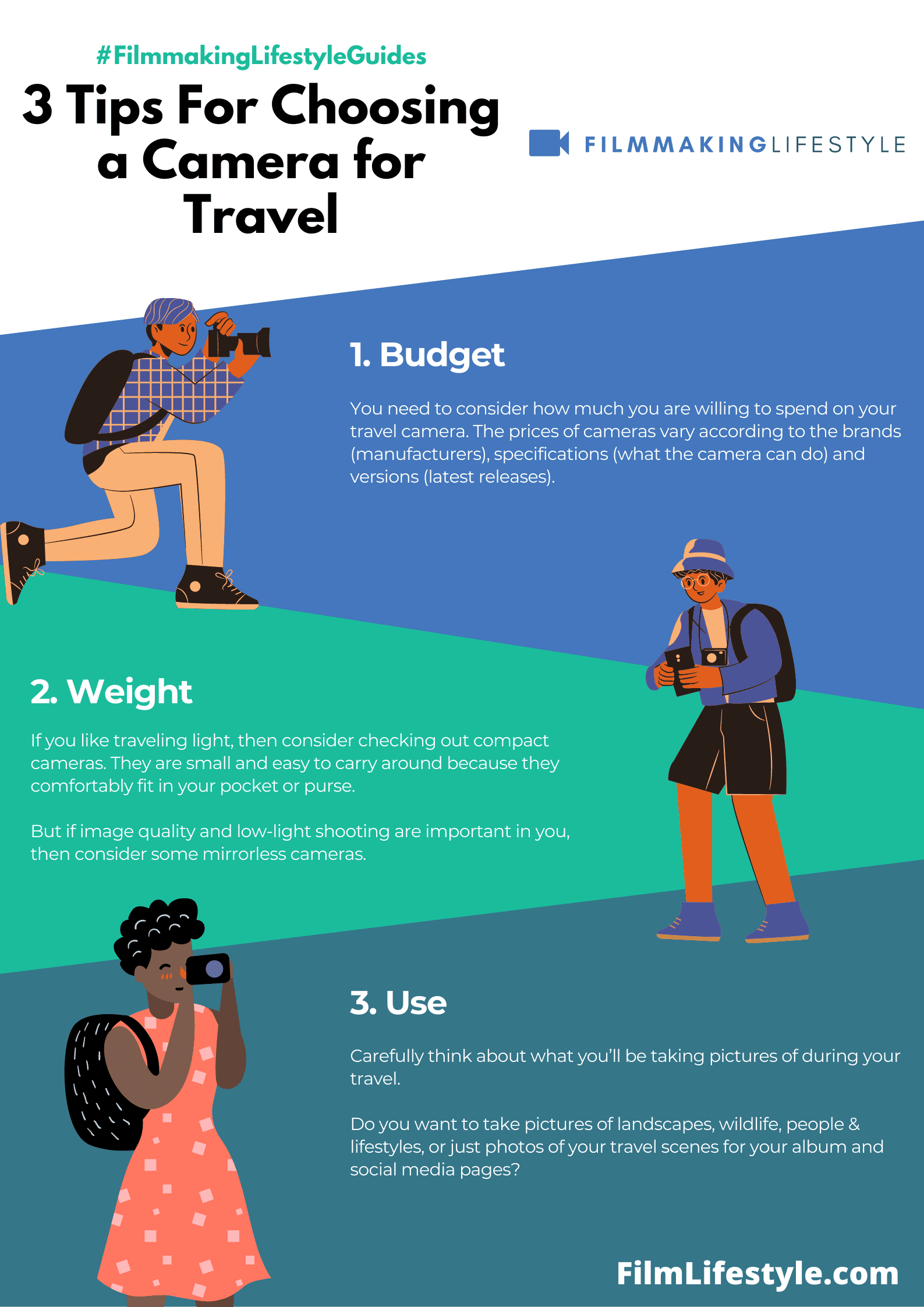
Use
Carefully think about what you’ll be taking pictures of during your travel.
Do you want to take pictures of landscapes, wildlife, people & lifestyles, or just photos of your travel scenes for your album and social media pages?
To help you choose the best camera for travel, we have mentioned a few examples of the best uses for each camera cited in this post.
Extra Features
The essential features to consider for image quality are the sensor size, optical zoom, aperture range and manual controls.
Nowadays, most cameras come with extra features like tilting LCD screens, video recording, touchscreen interfaces, Wi-Fi, built-in GPS, weather-proofing etc.
A feature like GPS can help you easily remember where your shots were taken during your travel adventure. Also, a Wi-Fi & Bluetooth feature enables you to send photos online or remotely control your camera via your smartphone.
What Are Travel Cameras?
A travel camera is a lightweight, portable device that allows for easy and convenient photography on the go.
Travel cameras are often small enough to be carried around in your pocket or purse, making them perfect for capturing spontaneous moments wherever you are.
Technology has come a long way since the days of film cameras and bulky digital cameras.
Advantages of Using Travel Cameras
• Gives you the power of having gear and lenses in one small, convenient package.
• You won’t be stuck using low quality images when you get back from a vacation or trip abroad. Your photos will look professional.
• Better quality photos with impeccable image detail.
• Are more discreet and lightweight than a DSLR camera + gear.
• Travel-friendly design fits easily in your pocket or bag, which is perfect for travel photographers on the go!
Now check out our picks for the 14 best cameras for travel across the compact, mirrorless, and action camera categories.
Best Camera for Travel – The Cameras
Let’s now jump right into the camera recommendations!
1. Sony RX100 VII
Build and Design
The Sony RX100 VII, a continuation of the RX100 series, is a pocket-friendly camera that doesn’t compromise on build quality.
Constructed with a mix of metal and high-quality plastics, it feels solid in hand and exudes a premium aura.
Despite its compact form factor, the camera manages to cram in a plethora of controls, which cater to both enthusiasts and professionals alike.
Sensor and Image Quality
At the heart of the RX100 VII lies a 20.1MP 1-inch stacked CMOS sensor coupled with the BIONZ X image processor.
This combination ensures crisp, detailed, and vibrant images across a variety of lighting conditions.
The ISO range of 100-12,800 can be extended up to 64,000, allowing for commendable low-light performance.
The camera also supports continuous shooting at an impressive 20 fps without any blackout, a feature often found in high-end mirrorless cameras.
Lens and Autofocus
The RX100 VII boasts a versatile 24-200mm (35mm equivalent) Zeiss Vario-Sonnar T* lens with an aperture range of f/2.8-4.5.
This lens range covers a broad spectrum, from wide-angle to telephoto, enabling users to capture a wide variety of scenes without the need for lens swapping.
The autofocus system is another standout feature.
With a whopping 357 phase-detection and 425 contrast-detection points, the RX100 VII locks onto subjects swiftly and accurately, making it ideal for capturing fast-moving subjects.
Video Capabilities and Additional Features
On the video front, the RX100 VII is no slouch. It offers 4K video recording with full pixel readout and no pixel binning, ensuring sharp and detailed footage.
High Frame Rate (HFR) recording allows users to capture stunning slow-motion sequences at up to 1000 fps.
Furthermore, the camera is equipped with a microphone jack, a feature that videographers will undoubtedly appreciate.
The addition of the Real-time Tracking and Real-time Eye AF for both humans and animals ensures that subjects remain sharp and in focus during photo and video capture.
The Sony RX100 VII solidifies its position as a top-tier compact camera with its impressive feature set.
From stellar image quality to robust video capabilities, it appeals to both photographers and videographers alike.
While its price might be on the higher side for a compact camera, the value it offers in terms of performance and versatility is hard to contest.
The RX100 VII is a testament to Sony’s commitment to pushing boundaries in the realm of compact cameras.
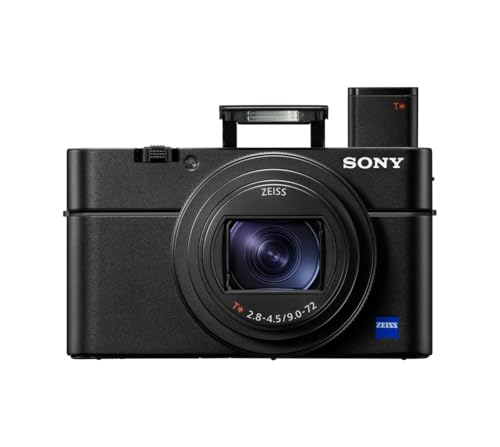
Sony
- 20. 1MP 1. 0 Type stacked CMOS sensor, Zeiss Vario Sonnar T 24 200 millimeter F2. 8 F4. 5 large aperture high magnification zoom lens
- 0. 02 sec. High AF speed, 357 point focal plane Phase detection AF and 425 point contrast detection AF
- Up to 20 fps blackout free shooting, using up to 60 times/sec. AF/AE calculations. Diopter Adjustment: -4.0 to +3.0 m-1. Operating Temperature- 0 degrees C.- +40 degrees C. / 32 degrees F. - 104 degrees F
- AI based real time tracking for stills and movies, and touch tracking. Real time eye AF for human (stills and movies), and for animal (stills only)
- 4K video with us log3 and Interval Shooting. Microphone jack and vertical position data recording. Active mode image stabilization in 4K video recording, and Movie Edit add on compatible
20. 1MP 1. 0 Type stacked CMOS sensor, Zeiss Vario Sonnar T 24 200 millimeter F2. 8 F4. 5 large aperture high magnification zoom lens 0. 02 sec. High AF speed, 357 point focal plane Phase detection AF and 425 point contrast detection AF
View on Amazon2. Canon Powershot G7 X Mark III
Build and Design
The Canon PowerShot G7 X Mark III carries on the sleek, compact design that’s become synonymous with the G7 X series.
It sports a robust metal body that lends it a premium feel without adding unnecessary weight, ensuring it remains portable and easy to handle.
The control layout is intuitive with a control ring around the lens which can be customized for a variety of settings, making the G7 X Mark III a very user-friendly camera.

Charge what you’re worth — and hear “yes” more often
Positioning and follow-up tactics from the Get More Video Clients guide so you stop under-quoting and start winning work that fits your rates.
Sensor and Image Quality
The PowerShot G7 X Mark III is equipped with a 20.1MP 1-inch stacked CMOS sensor that’s capable of delivering sharp and clear images.
The DIGIC 8 Image Processor further enhances image quality, reducing noise, and rendering accurate colors.
The camera performs admirably in various lighting conditions, thanks to its native ISO range of 125-12,800, which can be expanded further if needed.
The images produced have a good dynamic range and display a pleasing color reproduction, which is what we have come to expect from Canon’s color science.
Lens and Autofocus
With a 24-100mm (35mm equivalent) f/1.8-2.8 lens, the G7 X Mark III offers a versatile zoom range suitable for a variety of shooting scenarios from wide-angle to short telephoto.
The lens’s bright maximum aperture is a boon for low-light shooting and achieving a shallow depth of field.
On the autofocus front, the G7 X Mark III features Canon’s reliable autofocus system.
It may not be the fastest in the class but it’s accurate and performs well in good lighting conditions.
Video Capabilities and Additional Features
Video recording is a strong suit of the G7 X Mark III. It can record 4K video at 30fps and Full HD video at 120fps.
The lack of cropped 4K and the inclusion of a microphone jack are big pluses for vloggers and videographers.
Additionally, the camera’s live streaming functionality directly to YouTube is a unique feature that sets it apart from competitors.
The flip-up touchscreen LCD is also a handy feature for vloggers and selfie enthusiasts.
The Canon PowerShot G7 X Mark III builds upon the success of its predecessors while adding modern features like uncropped 4K video and live streaming capabilities.
Its user-friendly design, versatile lens, and solid image quality make it a well-rounded compact camera for a variety of users.
While its autofocus system could see some improvements, the overall performance and features offered by the G7 X Mark III cement its place as a strong contender in the compact camera market.
One practical caveat: viral demand has made new G7 X Mark III stock chronically scarce at list price, so check current retailer availability before counting on finding one quickly.

Canon
- 20.1 Megapixel 1.0” stacked CMOS sensor and DIGIC 8 Image processor.
- 4.2x optical zoom Lens (24-100mm f/1.8-2.8) with optical image Stabilizer.
- 4K 30P/ FHD 120P video.
- Turn your Canon camera into a high-quality webcam--Learn more: canon.us/livestream
- Use the EOS Utility Webcam Beta Software (Mac and Windows) to turn your Canon camera into a high-quality webcam, or do the same using a clean HDMI output.
20.1 Megapixel 1.0” stacked CMOS sensor and DIGIC 8 Image processor. 4.2x optical zoom Lens (24-100mm f/1.8-2.8) with optical image Stabilizer.
View on Amazon3. Fujifilm X-T5
Build and Design
Fujifilm discontinued the X-T4 in 2022. Its successor, the X-T5, exudes a sense of nostalgia with its retro-inspired design while integrating modern camera technology.
Built with a magnesium alloy body, the camera is both lightweight and sturdy.
The external dials and buttons give users direct access to vital settings, embracing the tactile approach of vintage cameras.
Moreover, the X-T5 is weather-sealed, ensuring protection against dust, moisture, and minor splashes, making it suitable for outdoor photography.
Sensor and Image Quality
At the core of the X-T5 is a 40.2MP X-Trans CMOS 5 HR sensor, a substantial jump from the X-T4’s 26.1MP chip, combined with the X-Processor 5 image engine.
Together, they produce images with rich color rendition, detailed resolution, and low noise even at higher ISO values.
Fujifilm’s famed film simulations, such as Velvia, Acros, and Classic Chrome, offer a unique and creative approach to color and monochrome photography.
The camera ensures flexibility across various lighting conditions.

Autofocus and In-body Stabilization
One of the standout features of the X-T5 is its advanced hybrid autofocus system, now with subject-detection for animals and vehicles that the X-T4 lacked.
The camera provides quick and accurate focusing in both stills and video modes.
It also excels in tracking moving subjects, which is especially useful for action or wildlife photography.
A major feature of the X-T5 is 5-axis in-body stabilization (IBIS), offering up to 7 stops of shake reduction, an improvement on the X-T4’s 6.5 stops.
This IBIS system proves invaluable for hand-held shooting in low light conditions and during video recording.
Video Capabilities
The X-T5’s prowess isn’t limited to photography. On the video front, the camera is capable of recording up to 6.2K at 30fps and Full HD up to 240fps for slow-motion capture.
With 10-bit internal recording and F-Log2 profile, filmmakers get a vast dynamic range and flexibility in post-production.
The addition of the IBIS enhances the camera’s video capabilities, delivering stabilized footage even without a gimbal.
The Fujifilm X-T5 is a comprehensive mirrorless camera that caters to both photographers and videographers.
With its impressive image quality, advanced autofocus, and cutting-edge video features, it stands out as one of the top contenders in its category.
The blend of retro aesthetics with contemporary technology makes the X-T5 not just a camera but a delightful photographic experience.
Whether you’re a street photographer, a videographer, or someone in between, the X-T5 is a compelling choice.
4. Panasonic Lumix ZS200D
Build and Design
Panasonic has discontinued the ZS200/TZ200 line, including the ZS200D. There is no current Panasonic successor with the same 1-inch sensor and long zoom, so the ZS200D remains the used-market pick when you want that travel-zoom formula.
With a metal body that feels durable and premium, it’s evident Panasonic didn’t cut corners in its construction.
The camera’s ergonomic grip ensures a comfortable hold, making it ideal for extended use during travels.
Despite its compact dimensions, the ZS200D manages to house a built-in electronic viewfinder (EVF) alongside a touch-enabled LCD, which is a noteworthy addition for a camera in this category.
Sensor and Image Quality
Inside the ZS200D is the same 20.1MP 1-inch sensor as its predecessor, a size usually reserved for premium compact cameras.
This sensor promises detailed and clear images, especially when combined with the Venus Engine processor.
The camera’s dynamic range is impressive, capturing detail in both shadows and highlights effectively.
The ISO range ensures adaptability in various lighting conditions.
In practical use, images up to ISO 1600 maintain good detail and color fidelity, with higher values showing some noise.
Lens and Zoom Capabilities
A standout feature of the ZS200D is its Leica DC Vario-Elmar 24-360mm (35mm equivalent) lens, unchanged from the original ZS200.
This 15x optical zoom range is remarkable for a camera with a 1-inch sensor, allowing for flexibility between wide-angle landscapes and zoomed-in telephoto shots.
The lens has an aperture range of f/3.3 at the wide end to f/6.4 at the telephoto end.
While it might not be the brightest lens, the camera’s 5-axis hybrid optical image stabilization compensates, helping to achieve sharp images at slower shutter speeds.
Video Capabilities
The ZS200D is not just a stills camera; its video capabilities are also noteworthy.
It can record 4K videos at 30fps and Full HD videos at up to 120fps, which is suitable for creating slow-motion footage.
The 4K PHOTO mode, a feature Panasonic has championed, allows users to extract 8MP stills from 4K video footage, ensuring you never miss a fleeting moment.
The Panasonic Lumix ZS200D emerges as an impressive compact travel camera, balancing a commendable zoom range with a larger-than-average sensor.
Its combination of portability, a versatile lens, and a capable sensor makes it a top choice for those who want a no-fuss camera on their journeys — provided you’re shopping used or finding remaining new-old stock.
While there are some compromises, like the lens brightness, the overall package offered by the ZS200D is hard to overlook for those prioritizing zoom in a pocketable format.
5. Sony Alpha a6700
Build and Design
Sony has wound down production of the a6400, and the a6700 is now the mid-range mirrorless Sony points travel and hybrid shooters toward.
It keeps the same compact, lightweight footprint the a6000 series is known for, in a robust magnesium alloy shell.
The ergonomic grip is deeper than the a6400’s, which helps with longer handheld sessions, and the 180-degree tiltable touchscreen LCD remains a favorite for vloggers and selfie shooters.
Weather sealing is improved over the a6400, and a dedicated stills/video/S&Q switch on the top plate speeds up mode changes on the move.
Sensor and Image Quality
The a6700 steps up to a newer 26MP APS-C back-illuminated (BSI) sensor, a jump from the a6400’s 24.2MP chip, paired with a dedicated AI processing unit rather than relying on the BIONZ X engine alone.
Its ISO range of 100-32,000, expandable to 102,400, delivers sharp, high-resolution images with excellent color accuracy and better low-light noise control than its predecessor.
Sony’s color science ensures natural skin tones and vibrant landscapes, making the images suitable for various genres.
Autofocus and Performance
The a6700’s AI-driven autofocus recognizes and tracks humans, animals, birds, insects, cars, trains, and planes, a significant expansion on the a6400’s subject-detection.
With 425 phase-detection points covering the frame, the camera excels at tracking subjects in stills and video alike, and Sony’s Real-time Eye AF and Real-time Tracking carry over and are noticeably stickier in practice.
Continuous shooting reaches up to 11fps with continuous AF/AE tracking, making it suitable for action and travel photography where subjects move unpredictably.
Video Capabilities
The a6700 adds 5-axis in-body image stabilization, which the a6400 lacked entirely, so handheld travel footage looks steadier straight out of the camera.
It records 10-bit 4:2:2 4K up to 60p with full pixel readout and no pixel binning, well beyond the a6400’s 4K/30p ceiling, and offers S-Log2, S-Log3, and S-Cinetone profiles for dynamic range and color grading flexibility in post.
Improved heat dissipation lets it sustain long 4K clips without the overheating limits that affected earlier a6000-series bodies.
The Sony Alpha a6700 is the versatile, AI-assisted mirrorless camera that has effectively replaced the a6400 in Sony’s current lineup for travelers who want a small body with serious autofocus and video.
Its blend of rapid subject tracking, higher-resolution imaging, in-body stabilization, and stronger video specs justifies stepping up from the older a6400, especially for anyone shooting handheld while on the move.
6. GoPro HERO13 Black
Build and Design
GoPro has moved several generations past the HERO9 Black; the current flagship, the HERO13 Black, continues the legacy of GoPro’s rugged and compact design, tailored for extreme action and adventure.
Encased in a waterproof body that can withstand depths of up to 33 feet without an external case, this camera is built for durability.
A front-facing color display remains standard, facilitating framing for vlogging and selfie shots.
A new magnetic lens mod mount, absent on the HERO9 Black, lets you swap in macro, anamorphic, or ND-filter lenses without changing bodies.
Performance and Image Quality
The HERO13 Black is equipped with a larger sensor than the HERO9’s 23.6MP chip, enabling sharper photos at up to 27MP and 5.3K video recording at up to 60fps, well beyond the HERO9’s 5K/30fps ceiling.
The colors are vibrant, and the dynamic range is impressive, capturing details in challenging lighting scenarios.
GoPro’s HyperSmooth 6.0 stabilization technology ensures that footage remains silky smooth even in the most tumultuous situations, a clear step up from the HERO9’s HyperSmooth 3.0.
Features and Usability
One of the standout features of the HERO13 Black is horizon leveling, which ensures that your videos remain straight and aligned, even if the camera is tilted or rotates during recording.
HindSight carries over, capturing footage from before you hit the record button so you don’t miss crucial moments.
For vloggers and streamers, the HERO13 Black also offers webcam functionality and live streaming.
The camera’s modularity, allowing the addition of mods like the Media Mod, Light Mod, and the new magnetic lens mods, provides flexibility for various shooting scenarios.
Battery and Storage
GoPro has continued to refine battery life generation over generation since the HERO9, and the HERO13 Black’s Enduro battery is built to perform in a wider range of temperatures, useful for cold-weather travel shooting.
This enhancement is a boon for those long shooting sessions and adventures where charging opportunities are scarce.
Additionally, the camera supports a high-speed microSD card to ensure smooth 5.3K recording and swift file saves.
The GoPro HERO13 Black stands out as a formidable action camera, encompassing a plethora of advanced features in a sturdy, compact frame.
With enhancements in image quality, stabilization, battery life, and user-focused features, it sets a new benchmark in the action camera domain.
Whether you’re an adventurer, vlogger, or a casual user, the HERO13 Black promises performance that justifies its position at the pinnacle of GoPro’s lineup.
7. OM System Tough TG-7
Build and Design
Olympus’s camera division is now OM System, and the Tough TG-6 has been discontinued and replaced by the OM System Tough TG-7, which stays true to the line’s name with a build that is virtually indestructible for a compact camera.
It’s designed to thrive in conditions where most cameras would falter.
This rugged device is waterproof up to 50 feet, freeze-proof down to 14°F, crush-proof up to 220 pounds of force, and shockproof from drops up to 7 feet, matching the TG-6’s already-tough ratings.
Its robust construction is complemented by a high-resolution rear LCD with an anti-glare coating, which is invaluable for outdoor usage, and the TG-7 adds USB-C charging in place of the TG-6’s older micro-USB port.
Performance and Image Quality
Featuring the same 12MP BSI CMOS sensor as its predecessor, the TG-7 provides clear and vibrant images across a range of conditions.
Its fast f/2.0 lens is adept at low-light shooting, a rarity for rugged cameras.
The camera also boasts a 4x optical zoom, offering versatility in shot composition.
Macro enthusiasts will appreciate the TG-7’s exceptional close-up shooting capabilities, with its macro modes that can capture subjects just 1cm away from the lens.
Features and Usability
The TG-7 offers a plethora of shooting modes and features tailored for outdoor adventures.
Its underwater modes optimize settings for deep-sea shooting, correcting the white balance to reproduce original underwater colors.
The Field Sensor System, integrating a GPS, manometer, compass, and temperature sensor, records tracking data and environmental readings, enhancing the adventure photography experience.
For those keen on capturing fast action, the TG-7 doesn’t disappoint with its high-speed movie mode, capable of recording up to 240fps in Full HD.
The TG-7 also adds support for the RM-WR1 weatherproof wireless remote, a first for this line.
Battery and Storage
Battery life is on par with the TG-6’s roughly 340 shots per charge, so adventurers might want to pack an extra battery for extended trips.
Its USB-C charging capability is convenient, allowing users to charge the camera on-the-go using power banks or laptops.
For storage, the camera supports SD, SDHC, and SDXC cards, ensuring ample space for high-resolution photos and videos.
The OM System Tough TG-7 stands out in the realm of rugged compact cameras.
Its blend of durability, imaging capabilities, and features tailored for outdoor enthusiasts makes it an unbeatable choice for those who find themselves often venturing into the wild.
Whether you’re diving deep underwater, scaling snowy peaks, or simply enjoying a beach day, the TG-7 ensures you capture every moment in stunning detail, regardless of the environment.
8. Canon EOS R50 V
Canon discontinued the entire EOS M system, including the M50 Mark II, in October 2023 — the EF-M mount is dead. For travelers who are also aspiring filmmakers, Canon’s current RF-mount vlogging camera, the EOS R50 V, is a compelling choice.

Stop under-scoping jobs on the discovery call
The Discovery Call Checklist walks you through the questions that surface scope, budget, and timeline — before you send a quote you’ll regret.
It blends high-quality video recording with portability, a feature set that’s crucial for capturing footage on the go.
This camera is not only lightweight and compact, but it’s also equipped with impressive video capabilities.
Users can record full-width 4K at up to 30p (4K/60p incurs a crop) and use the built-in microphone jack for enhanced audio, an essential for high-caliber travel vlogs.
Among its standout features are:
- Deep-learning subject-detection AF – smooth, accurate autofocus that keeps your subject in clear view, a generation ahead of the M50 Mark II’s Dual Pixel system.
- Vari-angle touchscreen – making it easy to shoot at tricky angles and compose your shots perfectly.
The R50 V supports webcam functionality as well, which is perfect for live streaming your adventures.
Plus, with wireless connectivity, sharing your cinematic creations is simpler than ever.
Not to be overlooked is the EOS R50 V’s ability to shoot vertical videos, tapping into the demand for content fitting for mobile platforms.
With social media’s growing influence on travel filmmaking, this feature is particularly relevant.
Even for more advanced productions, the camera’s compatibility with Canon’s current and still-growing RF lens lineup ensures both flexibility and quality — unlike the M50 Mark II’s now-frozen EF-M mount.
The investment in lenses will not only enhance travel films but serve well in future filmmaking endeavors.
It’s clear that the Canon EOS R50 V is designed with the modern content creator in mind.
Built to cater to a variety of filming situations, its versatility shines through whether you’re capturing panoramic landscapes or immersive street scenes.
9. Sony A7C II
Sony discontinued the original A7C globally in late 2023 in favor of its successor, the A7C II, which combines portability with full-frame performance in a package that’s perfect for travel filmmakers.
It carries on the original A7C’s claim as one of the smallest and lightest full-frame interchangeable lens cameras, now with a newer processing engine and powerful features that don’t compromise on quality.
At the heart of the A7C II is a 33-megapixel back-illuminated sensor — more resolution than the original A7C’s 24.2MP chip — delivering high sensitivity and reduced noise.
With advanced color reproduction, it creates footage that’s rich and lifelike, which is essential for capturing the true essence of your travels.
This camera offers impressive video capabilities:
- 4K video recording with full pixel readout
- S-Log3 and HLG picture profiles for advanced color grading
- Continuous Autofocus (AF) with Eye Autofocus in both stills and video
The A7C II’s compact size doesn’t mean a sacrifice on durability.
It boasts a robust magnesium alloy body that’s ready to withstand the rigors of adventure.
The A7C II’s hybrid autofocus system, now powered by Sony’s dedicated AI processing unit, keeps subjects tack sharp in both stills and video.
Wireless connectivity is smooth with the A7C II’s built-in Wi-Fi and Bluetooth, facilitating seamless transfer to various devices without needing to plug in cables mid-shoot.
Lens selection has an expansive reach with the Sony E-mount system, from wide-angle to telephoto, adapting to nearly any filming scenario a travel shoot throws up.
The Sony A7C II’s versatility is a key asset for travel filmmaking, adapting to diverse shooting environments without weighing a kit down.
10. OM System OM-5 Mark II
Panasonic discontinued the Lumix GX9 years ago with no direct successor, as the brand has shifted its Micro Four Thirds efforts toward the video-centric GH and G series. For that same compact, travel-friendly Micro Four Thirds experience, the OM System OM-5 Mark II (from Olympus’s former camera division, refreshed in June 2025) stands out as a compelling current choice.
It combines a classic, weather-sealed design with advanced technology to meet the demands of modern travel filmmaking.
The OM-5 Mark II is particularly praised for its 20.4-megapixel Micro Four Thirds sensor which captures sharp, high-resolution images, on par with the GX9’s resolution but backed by a newer processor.
Its video prowess is notable as well – offering Cinema 4K recording that’s perfect for travel vlogs and documentaries.
One of the standout features of this camera is its 5-axis in-body image stabilization, rated up to 7.5 stops with compatible Sync IS lenses (about 6.5 stops with body IBIS alone).
This system ensures smooth footage even when the journey gets bumpy.
Dual image stabilization works with select lenses for an even greater level of control.
Crafting a professional look for your films is easier with the OM-5 Mark II thanks to its color and monochrome profiles.
These options grant filmmakers the flexibility to inject creativity into every frame.
The camera also supports Bluetooth and Wi-Fi connectivity, making it a breeze to transfer files on the go.
Here are some of its compelling features for travel filmmaking:
- Compact, weather-sealed body (rated IP53) paired with powerful performance — a durability advantage the discontinued GX9 never had
- Built-in electronic viewfinder for versatile shooting angles
- Intuitive controls and a touch-enabled, fully-articulating LCD for efficient operation
The OM-5 Mark II’s advanced autofocus system keeps your subjects in clear view, enhancing the overall cinematic quality.
With its face and eye detection technology, capturing expressive travel scenes becomes second nature.
OM System has designed the OM-5 Mark II to be a travel-friendly companion without sacrificing the essentials needed for high-quality film production.
Its range of compatible Micro Four Thirds lenses and accessories turns it into a versatile tool tailor-made for filmmakers on the move.
The camera’s lightweight profile ensures you’re always ready to capture the moment, no matter where your travels take you.
11. Nikon Z50 II
Nikon replaced the original Z50 with the Z50 II in November 2024. When considering cameras that strike an excellent balance between ease of use for beginners and enough control for seasoned filmmakers, the Z50 II is a standout contender.
It builds on Nikon’s first DX-format mirrorless camera, bringing the power of the Z series to a more compact and affordable form, now with the newer Expeed 7 processor.
The Z50 II is equipped with the same 20.9-megapixel APS-C sensor that made the original sharp, delivering stunning image quality and excellent low-light performance.
Its ability to shoot 4K video without a crop makes it a fantastic option for travel filmmakers looking to capture high-quality footage without lugging around heavy gear.
Here are some top features of the Nikon Z50 II:
- Compact, lightweight body ideal for travel
- 20.9-megapixel APS-C sensor for high-resolution videos and stills
- Uncropped 4K video recording capabilities
- Tiltable touchscreen LCD perfect for vlogging
- Robust build and comfortable grip to ease long shooting sessions
With the Nikon Z50 II, filmmakers can take advantage of 3D subject-tracking AF (borrowed from Nikon’s flagship bodies) and fast continuous shooting for capturing fast-moving subjects with precision — noticeably more reliable than the original Z50’s autofocus.
It’s a game-changer for travel vlogging where staying in focus and not missing a beat are crucial.
This camera also supports SnapBridge, allowing for seamless sharing and transfer of images and video footage.
This connectivity, paired with its impressive battery life, ensures filmmakers can shoot and share content all day without missing a moment.
12. DJI Osmo Pocket 3
DJI has moved this line on twice since the original Osmo Pocket, and the current Osmo Pocket 3 takes portability to a new level without compromising on the video quality we need.
Its remarkably small size houses a powerful camera that’s a true ally for any travel filmmaker.
At just a few inches tall, this device is engineered to be the perfect travel companion.
It boasts a 3-axis stabilized camera built around a much larger 1-inch sensor than the original Pocket’s tiny 1/2.3-inch chip, ensuring smooth, cleaner-looking footage even on the move.
The Osmo Pocket 3 doesn’t just impress with stabilization – its 4K video capability at up to 120fps delivers incredible detail and depth in every frame, well beyond the original Pocket’s 4K/60fps ceiling, along with genuinely improved low-light stills.
- Video resolution – 4K Ultra HD at up to 120fps
- Sensor – 1-inch, a major upgrade from the original Pocket
- Gimbal – 3-axis stabilization with a rotating touchscreen for vertical framing
Its Pro mode enables manual adjustment for ISO, exposure, and other critical settings, giving the flexibility to adapt to various lighting conditions and capture scenes exactly as envisioned.
The Osmo Pocket 3 isn’t solely for video; it’s a versatile tool, offering features like ActiveTrack, FaceTrack, and Timelapse for travel filmmaking on the road.
Battery life remains a top concern for travel filmmakers, and the Osmo Pocket 3 delivers around 166 minutes of operation at 1080p/24fps — a solid step up from the original Pocket — and it charges to 80% in just 16 minutes, meaning more shooting time with less downtime.
DJI’s Mimo app rounds out the package for editing footage and sharing travel stories on the go.
DJI has since announced a successor, the Osmo Pocket 4, but it is not available for legal US sale while FCC authorization remains blocked, so the Osmo Pocket 3 remains the current buyable pick for US travelers and a solid, discreet choice for documenting adventures.
13. Panasonic Lumix G100
Moving forward to a camera that impeccably marries vlogging and portability, we’ve got the Panasonic Lumix G100.
It’s a vlogging powerhouse that fits perfectly in the palm of your hand.
With its distinct audio tracking feature, it ensures that your subject is heard as well as seen.
Also, the Lumix G100 offers an impressive 4K video capability, a boon for quality-conscious filmmakers on the go.
Packing a punch with a 20.3-megapixel sensor, this camera delivers crisp and clear images. Panasonic now sells the model as the G100D, a minor update that swaps the original G100’s TFT LCD viewfinder for an OLED EVF and switches its charging port to USB-C; the core sensor, lens, and video specs are unchanged.
Its free-angle LCD touchscreen makes it effortless to capture high and low-angle shots with a simple touch.
For filmmakers who relish capturing vivid details and textures, the Lumix G100 doesn’t disappoint.
It provides an arsenal of features tailored for top-tier video creation:
- 5-axis hybrid image stabilization for ultra-smooth footage
- Advanced audio with OZO Audio by Nokia, capturing clear sound from the environment or your subject
- Face recognition autofocus for keeping your subjects in sharp focus effortlessly
Integration with smartphones for instant sharing is flawless, thanks to the dedicated Lumix Sync app.
Not only does this streamline the process of getting your content online, but it also simplifies remote control functionalities.
These conveniences make the Lumix G100 a preferred choice for filmmakers who require efficiency alongside quality.
It’s about the subtleties with the Lumix G100, which not only has robust video and audio capabilities but also boasts a stylish and ergonomic design.
Easy to carry and discreet in public, this camera empowers filmmakers to shoot with confidence and creativity.
Whether it’s a bustling street or a quiet landscape, the Lumix G100 is equipped to bring your filmmaking visions to life.
14. Fujifilm X100VI
Fujifilm has discontinued the X100V; its successor, the Fujifilm X100VI, is no exception to the line’s reputation.
It’s a fusion of classic design and modern technology that’s particularly appealing for filmmakers who travel.
The camera boasts a 23mm F2 fixed lens which delivers exceptional image quality, especially in low light conditions.
Paired with the 40-megapixel X-Trans CMOS 5 HR sensor — a substantial jump from the X100V’s 26.1MP chip — the X100VI captures stunning 6.2K video that’s sharp and full of detail, and now adds in-body image stabilization the X100V never had.
What sets the X100VI apart, aside from that stabilization, is its unique hybrid viewfinder, carried over from the X100V.
You have the option to switch between an optical viewfinder (OVF) and an electronic viewfinder (EVF), providing versatility in how you compose your shots.
A few other features worth highlighting:
- Weather-resistant body when paired with the optional adapter ring and lens filter
- Improved autofocus performance with subject-detection AF (animals, vehicles) that the X100V lacked
- Integrated ISO dial embedded in the shutter speed dial for quick changes on the fly
Connectivity is a breeze with the Fujifilm X100VI’s built-in Wi-Fi and Bluetooth, simplifying the process of transferring footage to a smartphone or laptop while traveling.
Its compact size belies its powerful capabilities, making it a strong pick for filmmakers who prefer a smaller form factor without sacrificing the functions important for creating high-quality content.
One caveat worth flagging: demand has outstripped supply since launch, and Fujifilm has since raised the US price from $1,599 to $1,799, so stock and pricing can be tighter and pricier than older X100V listings once were — check current retailer availability before counting on picking one up quickly.
The tilting touchscreen LCD found on the X100VI makes low-angle shots and various other challenging compositions far more manageable, and external microphone support means better sound is possible without bulky add-on equipment.
The Fujifilm X100VI is a genuinely travel-friendly filmmaker’s camera, with straightforward usability mixed with advanced features for capturing footage wherever the trip goes.
Important Terms When Buying a Travel Camera
Aperture
This is the hole in the lens that lets light in. It is measured in numbers, starting with the letter “f” followed by a number, for example, f/1.8 or f/2.2. The smaller the number, the bigger the hole, and the more light that gets in even in dim locations.
Optical zoom
This signifies the largest magnification that the camera’s lens can attain. For example, a camera with a 10x optical zoom can make objects in the image appear 10 times larger when the camera is zoomed in.
Focal length
This is a number you’ll see on cameras with interchangeable lenses. It’s actually the correct photography term for optical zoom. It’s measured in “mm”, so a bigger focal length means more magnification by the lens.
EVF
This stands for Electronic Viewfinder. Though the EVF is smaller than the LCD screen on the back of the camera, they both show you what the camera’s sensor is seeing.
Megapixels
This is the number of pixels the camera’s sensor holds. Mega means million. Any camera with 12 megapixels (or 12 million pixels) is good enough. Anything more than that is only handy if you are going to print your photos on large-size billboards.
OIS / EIS
This stands for Optical Image Stabilization or Electronic Image Stabilization. They are technologies that offset small movements of the camera system which may affect image quality, e.g. your hand. Generally, a camera with OIS technology achieves better results.
Sensor size
This is a crucial specification to check when purchasing a camera. A camera with a bigger sensor captures more light, thus doing better in low-light situations.
RAW
This is a file format that allows you to save the image captured by the camera as unmodified data. Shooting and saving your image in RAW format offers you more control over how your image finally looks.
However, file sizes in RAW format are bigger than JPEG/JPG versions. Most cameras allow you the choice of shooting in RAW or JPEG or both.
Best Camera For Travel – In Conclusion
The travel cameras listed here suit a wide range of budgets, needs and expertise levels, but it is by no means an exhaustive list. Your choice of the best camera for travel depends on your needs and financial muscle.
So carefully think about which features and specs interest you most in order to make an informed decision. We hope that after reading this post, you’ll be able to choose the right camera- even if it isn’t one we’ve suggested here.
We have Gear Buyer’s Guides on every type of Filmmaking Equipment!
We have Gear Buyer's Guides on every type of Filmmaking Equipment!

10 Best Video Editing Tools for Beginners in 2026

Invideo Editor vs Veed: Which One in 2026?

How to Delete a Sentence From a Video by Editing the Transcript

10 Best Higgsfield Alternatives for AI Filmmaking in 2026

Best AI Tools for Making Microdramas in 2026

Best AI Tools for Storyboarding Before a Shoot

Invideo vs. Higgsfield: Which AI Filmmaking Platform Actually Delivers in 2026

AI Filmmaking in 2026: From Idea to Final Cut in One Connected Workflow
Best Video Editing Software for Freelance Videographers


New comments are not currently accepted.
Comments