
On this pageTap to expand
If you’re interested in cameras, you’ve probably heard of pocket cameras. These little devices can fit in your pocket and offer great photo and video capability without the price tag or learning curve of bigger cameras. But what is the best pocket camera?
There are so many different types of these cameras out there, so it can be tough figuring out which one is right for you. Our guide will help demystify this topic and find the perfect pocket camera for you.
Pocket cameras, sometimes called compact cameras, offer an alternative to DSLRs for those who want something more portable but still have high-quality images and video.
In this guide, we’ll discuss some of the benefits and drawbacks of pocket cameras in order to help you make an informed decision about which one might work for you!
We will compare prices, features, and use cases to help you find the perfect pocket camera for your needs.
2026 current picks (start here)
| Pick | Why it leads now |
|---|---|
| Sony RX100 VII | Still the pocket stills/video hybrid reference (1"-class stacked sensor, serious AF) |
| Sony ZV-1 II | Current vlog compact—18–50mm lens, flip screen, product showcase, mic input |
| Canon PowerShot G7 X Mark III | Canon content-creator compact with mic port and vertical video |
Currency note (August 2026): The vlog pick is the ZV-1 II. G1 X Mark III, LX100 II, and LX10/LX15 are used-market compacts. The Q3 and GR IV succeed the Q2 and GR III when you want the newest body in those lines.
Best Pocket Camera
Let’s jump right into the list of the best pocket cameras!
Every pick in this guide
| Pick | Notes (2026) |
|---|---|
| Sony RX100 VII | Lead pocket hybrid — full write-up as #1 |
| Sony ZV-1 II | Lead vlog compact — full write-up as #2 |
| Canon PowerShot G7 X Mark III | Lead Canon compact — full write-up as #3 |
| Canon Powershot G1 X Mark III | Legacy APS-C compact—used/value |
| Panasonic Lumix LX100 II | Legacy multi-aspect compact |
| Canon PowerShot G5 X Mark II | Compact with EVF |
| Panasonic Lumix LX15 / LX10 | Discontinued 1-inch compact—check used price |
| Fujifilm X100VI | Current fixed-lens X100 |
| Leica Q2 | Premium full-frame compact |
| Fujifilm XF10 | Compact APS-C |
| Ricoh GR III | Street APS-C pocket |
| Leica Q2 Monochrom | Niche mono Q |
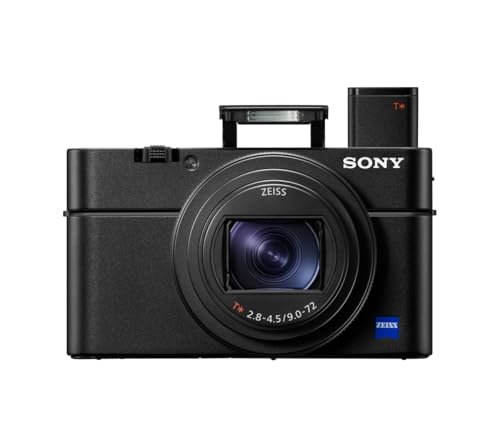
1. Sony RX100 VII
Sony
- 20. 1MP 1. 0 Type stacked CMOS sensor, Zeiss Vario Sonnar T 24 200 millimeter F2. 8 F4. 5 large aperture high magnification zoom lens
- 0. 02 sec. High AF speed, 357 point focal plane Phase detection AF and 425 point contrast detection AF
- Up to 20 fps blackout free shooting, using up to 60 times/sec. AF/AE calculations. Diopter Adjustment: -4.0 to +3.0 m-1. Operating Temperature- 0 degrees C.- +40 degrees C. / 32 degrees F. - 104 degrees F
- AI based real time tracking for stills and movies, and touch tracking. Real time eye AF for human (stills and movies), and for animal (stills only)
- 4K video with us log3 and Interval Shooting. Microphone jack and vertical position data recording. Active mode image stabilization in 4K video recording, and Movie Edit add on compatible
20. 1MP 1. 0 Type stacked CMOS sensor, Zeiss Vario Sonnar T 24 200 millimeter F2. 8 F4. 5 large aperture high magnification zoom lens 0. 02 sec. High AF speed, 357 point focal plane Phase detection AF and 425 point contrast detection AF
View on AmazonBest overall pocket hybrid in 2026
The RX100 VII remains the serious pocket camera when you need 1"-class image quality, fast AF, and 4K video without swapping lenses. Use it for travel, B-roll, and run-and-gun when a phone is not enough and a mirrorless body is too much.
Who should look elsewhere
Choose ZV-1 II when talking-head vlogs and product demos matter more than stills reach. Choose G7 X Mark III for Canon colour and a mic port in a similar compact shape.
2. Sony ZV-1 II

- Ultra-wide 18-50mm1 zoom lens gets it all in the frame
- Large 1.0-type sensor for professional results even in low-light
- Wide aperture F1.8-4.0 lens for beautifully defocused backgrounds
- Clear audio with directional 3-Capsule mic and wind screen accessory
- Stay in focus with Real-time autofocus tracking and Eye-AF
Best pocket camera for vlogging in 2026
The ZV-1 II is Sony’s current content-creator compact: a 20.1-megapixel 1-inch sensor, an 18–50mm-equivalent f/1.8–4 zoom, a side-articulated screen, Product Showcase setting, background Defocus button, directional mic, and a 3.5mm mic jack—built for facing-the-camera video rather than stills-first travel photography. It is wider than the original ZV-1 (24–70mm equivalent, f/1.8–2.8) and gives up that model’s longer reach.
- Ultra-wide 18-50mm1 zoom lens gets it all in the frame
- Large 1.0-type sensor for professional results even in low-light
- Wide aperture F1.8-4.0 lens for beautifully defocused backgrounds
- Clear audio with directional 3-Capsule mic and wind screen accessory
- Stay in focus with Real-time autofocus tracking and Eye-AF
3. Canon PowerShot G7 X Mark III

Canon
- 20. 1 Megapixel 1. 0” stacked CMOS sensor and DIGIC 8 Image processor.
- 4. 2x optical zoom Lens (24-100mm f/1. 8-2. 8) with optical image Stabilizer.
- 4K 30P/ FHD 120P video.
- Turn your Canon camera into a high-quality webcam--Learn more: canon.us/livestream
- Use the EOS Utility Webcam Beta Software (Mac and Windows) to turn your Canon camera into a high-quality webcam, or do the same using a clean HDMI output.
20. 1 Megapixel 1. 0” stacked CMOS sensor and DIGIC 8 Image processor. 4. 2x optical zoom Lens (24-100mm f/1. 8-2. 8) with optical image Stabilizer.
View on AmazonCanon creator compact
The G7 X Mark III pairs a 1"-class stacked sensor with a bright 24-100mm-equivalent zoom, uncropped 4K, a mic port, and vertical video—still a strong Canon pocket option for YouTube and social.
Canon
- 20. 1 Megapixel 1. 0” stacked CMOS sensor and DIGIC 8 Image processor.
- 4. 2x optical zoom Lens (24-100mm f/1. 8-2. 8) with optical image Stabilizer.
- 4K 30P/ FHD 120P video.
- Turn your Canon camera into a high-quality webcam--Learn more: canon.us/livestream
- Use the EOS Utility Webcam Beta Software (Mac and Windows) to turn your Canon camera into a high-quality webcam, or do the same using a clean HDMI output.
20. 1 Megapixel 1. 0” stacked CMOS sensor and DIGIC 8 Image processor. 4. 2x optical zoom Lens (24-100mm f/1. 8-2. 8) with optical image Stabilizer.
View on Amazon4. Canon Powershot G1 X Mark III
The Canon PowerShot G1 X Mark III is an older APS-C compact, not a current Canon body. It uses a 24.2-megapixel APS-C sensor, DIGIC 7 Image Processor, and a fixed 24–72mm-equivalent f/2.8–5.6 zoom (3x optical). It does not take an EF-M kit lens, and it is not a 24x superzoom.
The camera also has built-in Wi-Fi connectivity to enable remote control via smartphone and wireless transfer of files from computer to phone or vice versa without cables; it can additionally be used as a live viewfinder for compatible smartphones as well!
The Canon PowerShot G1 X Mark III is a high-end compact camera, with the look and feel of a DSLR.
It has the ability to take beautiful shots and capture crisp videos at high resolutions.
The LCD screen flips up 180 degrees for easy selfies, making it perfect for those who love taking pictures of themselves and their friends.
This camera also features built-in Wi-Fi, so you can wirelessly transfer photos and videos to your phone or tablet!
The Canon PowerShot G1 X Mark III is a capable camera that will make any photographer happy. Buy it used when you want a large-sensor pocket zoom.

Canon
- 24.2 Megapixel CMOS (APS-C) sensor.
- 3x zoom Lens (24-72mm) with optical image stabilizer.
- Dual pixel CMOS AF with phase-detection.
- Digic 7 image processor, Iso 100-25600.
24.2 Megapixel CMOS (APS-C) sensor. 3x zoom Lens (24-72mm) with optical image stabilizer.
View on Amazon5. Panasonic Lumix LX100 II
The Panasonic Lumix LX100 II is an expensive camera, but it’s worth every penny.
It is a fixed-lens compact with a multi-aspect Four Thirds sensor—about 17 effective megapixels from a 21.77-megapixel chip—and a 24–75mm-equivalent f/1.7–2.8 lens. This camera also features 4K video recording at 30 frames per second. It is not an APS-C camera. If you are looking for a high-end compact, treat it as a used buy.

AI can ideate — this guide helps you get paid
Use tools to move faster, then plug outputs into a real-world client strategy: positioning, outreach, and follow-up for video professionals.
It has an enlarged viewfinder that makes it easy for photographers to see their subjects, even in low light conditions.
The large sensor allows for more detailed pictures than those taken by smaller sensors. The improved image stabilization system reduces blur from handshake. The camera also offers full manual controls as well as RAW file support.
It’s perfect for anyone who wants to take photos or videos while on the go, without having to carry around a bulky DSLR.
The camera shoots in 4K video, which makes it useful when you want both stills and video in one pocket body.
One useful feature is its ability to connect wirelessly with your smartphone so you can easily transfer images or share them instantly online.

Panasonic
- Large Four Thirds sensor - 17 MP [4: 3 aspect] high-sensitivity multi-aspect Four Thirds MOS sensor. 4: 3, 3: 2, 16: 9, 1: 1 multi-aspect modes taken from 21.77 Megapixel total count
- Leica DC vario-summilux lens - 24-75 millimeter lens [F1. 7-2. 8], with power optical image Stabilizer (O. I. S.) to effectively compensate for hand shake, minimizing Blur during zoom shooting
- 4K video & 4K photo - Panasonic’s exclusive 4K photo technology uses 30 frames per second in high resolution 4K Ultra HD video to extract them as photos. You’ll never miss that moment again
- Macro shooting - Macro photography at 3 centimeter at wide-angle and 30 centimeter at telephoto. Photographs of flowers, plants and more reveal the fine details nearly invisible to the naked eye
- Camera body viewfinder and display – compact digital camera with electronic viewfinder EVF [2,764k-dot], and large 3-inch touch sensitive monitor [1240k-dot]
Large Four Thirds sensor - 17 MP [4: 3 aspect] high-sensitivity multi-aspect Four Thirds MOS sensor. 4: 3, 3: 2, 16: 9, 1: 1 multi-aspect modes taken from 21.77 Megapixel total count Leica DC vario-summilux lens - 24-75 millimeter lens [F1. 7-2. 8], with power optical image Stabilizer (O. I. S.) to effectively compensate for hand shake, minimizing Blur during zoom shooting
View on Amazon6. Canon PowerShot G5 X Mark II
The Canon PowerShot G5 X Mark II is a camera that can take beautiful photos. It’s compact and lightweight enough to fit in your pocket. You’ll love how easy this camera makes taking pictures!
The Canon PowerShot G5 X Mark II is a high-end compact camera that offers a lot of camera in a small package.
It is a 1.0-inch compact: about 20.1 megapixels on a stacked CMOS sensor, DIGIC 8, and one 24–120mm-equivalent f/1.8–2.8 zoom. It does not have two lenses.
The reduced body size makes it easier to carry around and the articulating touch screen simplifies shooting from low angles or difficult positions.
The Canon PowerShot G5 X Mark II has something for everyone: photographers looking for excellent image quality, vloggers who need good audio capture, and cinematographers looking for 4K video capabilities will all be satisfied by this versatile camera!
It has a pop-up electronic viewfinder, a mic input, 4K/30p, and a 3.0-inch touch screen for easy control over the menu and settings, as well as a single SD card slot so you can store photos or videos on your device without a second card slot.
With these features and more, this camera will give you everything you need to take amazing shots from any angle!

Canon
- 20. 1 Megapixel 1. 0” Stacked CMOS Sensor and DIGIC 8 Image Processor.
- 5x Optical Zoom Lens (24-120mm f/1. 8-2. 8) with Optical Image Stabilizer.
- 4K 30p / FHD 120p Video.
- Pop-up EVF with 2. 36 Million Dots, Touch and Drag AF.
- Use the EOS Utility Webcam Beta Software (Mac and Windows) to turn your Canon camera into a high-quality webcam, or do the same using a clean HDMI output.
- Max focal length: 120.0
20. 1 Megapixel 1. 0” Stacked CMOS Sensor and DIGIC 8 Image Processor. 5x Optical Zoom Lens (24-120mm f/1. 8-2. 8) with Optical Image Stabilizer.
View on AmazonSony RX100 VII (see #1)
The full write-up is under #1.
Sony’s Cyber-shot RX100 VII is an update to its previous offerings with a stacked sensor and processor. This means it will be able to take better pictures in low light conditions as well as faster processing.
The Sony Cyber-shot RX100 VII has a 20.1-megapixel 1″ Exmor RS stacked back-illuminated CMOS sensor, which is capable of capturing more light than before and has improved autofocus speeds thanks to the upgraded BIONZ X image processor.
The lens is a ZEISS 24–200mm-equivalent f/2.8–4.5 (8x optical zoom), not a 3x or 5x lens. 4K tops out at 30p; slow motion is in HD.
With these features, it is easy to see why this camera could be considered one of the best choices for a travel photographer or anyone who needs something compact but powerful enough for professional work.
Sony
- 20. 1MP 1. 0 Type stacked CMOS sensor, Zeiss Vario Sonnar T 24 200 millimeter F2. 8 F4. 5 large aperture high magnification zoom lens
- 0. 02 sec. High AF speed, 357 point focal plane Phase detection AF and 425 point contrast detection AF
- Up to 20 fps blackout free shooting, using up to 60 times/sec. AF/AE calculations. Diopter Adjustment: -4.0 to +3.0 m-1. Operating Temperature- 0 degrees C.- +40 degrees C. / 32 degrees F. - 104 degrees F
- AI based real time tracking for stills and movies, and touch tracking. Real time eye AF for human (stills and movies), and for animal (stills only)
- 4K video with us log3 and Interval Shooting. Microphone jack and vertical position data recording. Active mode image stabilization in 4K video recording, and Movie Edit add on compatible
20. 1MP 1. 0 Type stacked CMOS sensor, Zeiss Vario Sonnar T 24 200 millimeter F2. 8 F4. 5 large aperture high magnification zoom lens 0. 02 sec. High AF speed, 357 point focal plane Phase detection AF and 425 point contrast detection AF
View on Amazon7. Panasonic Lumix LX15 / LX10
The Panasonic Lumix LX15 and the LX10 are both very high-quality cameras. They are the same fixed-lens compact under different regional names. Both use a 20.1-megapixel 1-inch sensor and a 24–72mm-equivalent f/1.4–2.8 lens, and both record 4K. They are not interchangeable-lens cameras and they do not have a 20x zoom. The model is discontinued, so check the used price before treating it as a value buy.
These cameras are designed to be lightweight yet still deliver strong performance with 4K video recording capabilities.
The Panasonic Lumix LX15 is a compact with an impressive list of features. It has 4K video, which captures footage at four times the resolution of 1080p HD.
The zoom is a 3x optical zoom, and image stabilization helps reduce blurry images when you’re taking photos or shooting video on the go. This camera also takes strong pictures.
When it comes to photography, some people are ready and willing to invest in a high-quality camera. The Panasonic Lumix LX10 is that fixed-lens compact, with image stabilization rather than a separate wide-angle lens.
These cameras also offer Wi-Fi connectivity for wireless transfer from the camera.

Panasonic
- POINT-AND-SHOOT CAMERA: Large, 1-inch 20.1-megapixel MOS sensor plus 3X zoom LEICA DC VARIO-SU millimeter ILUX lens (24-72 millimeter) and POWER O.I.S. (Optical Image Stabilizer) delivers brighter, more colorful photos with fewer image artifacts
- TILTING SELFIE DISPLAY: Rear touch-enabled 3-inch LCD display (1040K dots) tilts upward 180 degree for easy selfie photos
- 4K VIDEO CAPTURE: 4K QFHD video recording (3840 x 2160), plus exclusive LUMIX 4K photo and 4K Post Focus with internal Focus Stacking allows you to record photos up to 30fps and set your desired focus points after the photo has been taken
- LENS-MOUNTED CONTROL RING: Manual lens-mounted control ring brings DSLR-like exposure control to a compact point-and-shoot camera body
- USB CHARGING AND WI-FI CONNECTIVITY: Enjoy travel ready technologies like USB charging and Wi-Fi connectivity to your mobile device; micro-HDMI type D (3) and USB 2.0 micro-B provide additional connectivity to your favorite devices
POINT-AND-SHOOT CAMERA: Large, 1-inch 20.1-megapixel MOS sensor plus 3X zoom LEICA DC VARIO-SU millimeter ILUX lens (24-72 millimeter) and POWER O.I.S. (Optical Image Stabilizer) delivers brighter, more colorful photos with fewer image artifacts TILTING SELFIE DISPLAY: Rear touch-enabled 3-inch LCD display (1040K dots) tilts upward 180 degree for easy selfie photos
View on AmazonSony ZV-1 II (see #2)
Note (2026): full lead write-up is under #2 above.
The ZV-1 II is the current 1-inch vlogging compact (18–50mm equivalent, f/1.8–4), with a flip screen, Product Showcase, background Defocus, directional onboard mic, and a 3.5mm mic jack. Prefer it when facing-camera video matters more than stills zoom reach; step to RX100 VII when stills/AF hybrid performance comes first.
- Ultra-wide 18-50mm1 zoom lens gets it all in the frame
- Large 1.0-type sensor for professional results even in low-light
- Wide aperture F1.8-4.0 lens for beautifully defocused backgrounds
- Clear audio with directional 3-Capsule mic and wind screen accessory
- Stay in focus with Real-time autofocus tracking and Eye-AF
Canon PowerShot G7 X Mark III (see #3)
The full write-up is under #3.
The Canon PowerShot G7 X Mark III is an excellent choice for those who are looking to take photos on the go or shoot high-quality video.
The lens is a 4.2x 24–100mm-equivalent f/1.8–2.8 zoom, not a 10x zoom or a constant f/2 lens, which still suits travel photography or shooting indoors without having to worry about cropping.
It also comes with a touchscreen display so navigating through settings and modes is simple and easy as well as Wi-Fi connectivity so uploading images can be done wirelessly.
This camera offers many great features but its main selling point is its ability to produce high-quality images.
This camera also offers powerful video capabilities including uncropped 4K UHD video recording at 30 frames per second.
With its 20.1-megapixel sensor and 24–100mm f/1.8–2.8 lens, you will be able to take beautiful low light shots with this camera.
The built-in wifi lets you share your photos instantly and NFC technology lets you connect wirelessly with other devices so that transferring files is quick and easy.
This camera also has a tilting 3″ touch screen LCD which makes it easier to compose your shot, review images, adjust settings or change shooting modes than ever before!
Canon
- 20. 1 Megapixel 1. 0” stacked CMOS sensor and DIGIC 8 Image processor.
- 4. 2x optical zoom Lens (24-100mm f/1. 8-2. 8) with optical image Stabilizer.
- 4K 30P/ FHD 120P video.
- Turn your Canon camera into a high-quality webcam--Learn more: canon.us/livestream
- Use the EOS Utility Webcam Beta Software (Mac and Windows) to turn your Canon camera into a high-quality webcam, or do the same using a clean HDMI output.
20. 1 Megapixel 1. 0” stacked CMOS sensor and DIGIC 8 Image processor. 4. 2x optical zoom Lens (24-100mm f/1. 8-2. 8) with optical image Stabilizer.
View on AmazonBest Prime Lens Compacts
Compact cameras are great for taking on the go, but they can’t handle low light conditions as well as their DSLR counterparts.
This is because of the smaller sensor size in a compact camera. To get around this problem, many photographers use prime lenses to create sharper images than what’s possible with a zoom lens.
Prime lenses also have wider apertures which allow more light to reach the sensor and achieve better performance in low-light scenes.
We’ve compiled a collection of prime lens compacts that we think stand out amongst their competitors.
8. Fujifilm X100VI
The Fujifilm X100VI is the current fixed-lens X100 body. It uses a 40.2-megapixel APS-C sensor, a 23mm f/2 lens (35mm equivalent), in-body stabilization, and a hybrid optical/electronic viewfinder.
The small size of the camera makes it easy to shoot photos in tight areas, follow subjects without being noticed, or bring on trips where weight restrictions are an issue.
The Fuji X-Series cameras have a long history of success due to their ability to capture beautiful images with gorgeous colors and crisp details.
The X100VI maintains this tradition with its fast f2 aperture lens that delivers clear shots even in low-light settings.
The Fujifilm X100 line is well known for its high-quality photos. A used X100V is the previous generation (26.1 megapixels, no in-body stabilization).
9. Leica Q2
In the market for a new camera? Leica may have just what you’re looking for. The Leica Q2 is designed to be small and lightweight, yet still offers powerful features like 4K video recording and a full-frame sensor.
The Leica Q2 is a full-frame compact with a 47.3-megapixel sensor and a fixed Summilux 28mm f/1.7 lens. It records 4K and shoots at up to 10 frames per second, and it has Wi-Fi for transfer. It is not an APS-C camera, and it does not have two sensors.
The current color Q is the Q3. The Q2 remains a premium fixed-lens body, not a budget compact.
Additionally, this camera has a much faster shooting speed than most DSLRs on the market today at 10 frames per second.
It also features WiFi connectivity for transferring photos and videos wirelessly through your phone or laptop.
With these updates, it’s safe to say that Leica has created one of the best pocket cameras on the market today!

Leica
- Leica Q2 digital camera (Black anodized).Sound recording format : AAC, Microphone : Stereo, Speaker : Mono.
Leica Q2 digital camera (Black anodized).Sound recording format : AAC, Microphone : Stereo, Speaker : Mono.
View on Amazon10. Fujifilm XF10
The Fujifilm XF10 is a camera that has been designed for everyday users. It is an older fixed-lens APS-C compact: 24 megapixels and an 18.5mm f/2.8 lens (28mm equivalent), with an intuitive user interface, so you can easily take high-quality pictures with minimal effort. It does not take interchangeable lenses.
The camera also has built-in Wi-Fi which allows you to share your photos instantly with friends and family on social media.
A camera with this many features for such a low price can’t be beaten!

Fujifilm
- 24.2MP APS-C CMOS sensor
- 3.0-Inch” (Approx. 1, 040k-dot) Color LCD Touchscreen, aspect Ratio 3: 2
- Standard output Sensitivity of Iso200 - Iso12800. Extended output Sensitivity of Iso100 - Iso51200
- Bluetooth version 4.1 low energy technology
- 4K 3840 x 2160 15P, continuous recording up to Approx. 30 Min.Operating frequency[Center frequency]:2402 - 2480MHz
24.2MP APS-C CMOS sensor 3.0-Inch” (Approx. 1, 040k-dot) Color LCD Touchscreen, aspect Ratio 3: 2
View on Amazon11. Ricoh GR III
The Ricoh GR III is a digital APS-C pocket camera with a fixed 18.3mm f/2.8 lens (28mm equivalent, 6 elements in 4 groups) and about 24 megapixels. There is no interchangeable lens mount.

You sell and shoot — keep discovery calls short & useful
A tight script you can run in 20–30 minutes so you’re not reinventing the wheel on every inquiry.
The camera also has dual control dials for shutter speed and aperture, making it easy for users of all levels to adjust their settings.
It has an APS-C sensor, and it’s housed in a magnesium-alloy body.
The Ricoh GR III can also shoot RAW files which are great for photographers who want to edit their photos before sharing them on social media.
The Ricoh GR III is a camera made for the everyday photographer. It’s lightweight, compact, and easy to use- perfect for weekend adventures or weekday commutes alike.
The GR III also features image processing that gives it strong low-light performance as well as color rendition and noise reduction.
It offers built-in Wi-Fi connectivity so you can share your photos from anywhere in the world!
The GR IV is the current GR if you want the newer body. The GR III remains the classic 28mm street compact.

Ricoh
- 24 MP CMOS Sensor with accelerator unit helps achieve remarkable image quality; 3 Axis; 4 Stop Shake Reduction ensures sharp images even in lower light conditions; It is also compatible with multi tone 14 bit RAW image recording
- 3 inches Air gapless Capacitive Touch LCD Screen makes controlling the GR III event easier with complete menu control as well as focus and shutter release; It is confirmed that a USB connection can be established between the camera and the following OS's; Windows 10(FCU, CU) (32 bit, 64 bit), Windows 8.1(32 bit, 64bit), Windows 8(32 bit, 64 bit), or Windows 7(32 bit, 64 bit); Mac macOS 10.14 Mojave, macOS 10.13 High Sierra, macOS 10.12 Sierra, OS X 10.11 El Capitan, OS X 10.10 Yosemite
- The GR III features a hybrid AF system combining a contrast type AF mechanism, superior in focusing precision with a phase detection type AF mechanism assuring high speed focusing operation; Taking advantage of both mechanisms, it assures faster, more responsive auto focus operation
- Full HD movie recording (1920 x 1080 pixels, 60 frame rate) in the H.264 recording format
- Compatible with Pentax AF 201, AF360 FGZ II & AF 540 FGZ II Flashes
24 MP CMOS Sensor with accelerator unit helps achieve remarkable image quality; 3 Axis; 4 Stop Shake Reduction ensures sharp images even in lower light conditions; It is also compatible with multi tone 14 bit RAW image recording 3 inches Air gapless Capacitive Touch LCD Screen makes controlling the GR III event easier with complete menu control as well as focus and shutter release; It is confirmed that a USB connection can be established between the camera and the following OS's; Windows 10(FCU, CU) (32 bit, 64 bit), Windows 8.1(32 bit, 64bit), Windows 8(32 bit, 64 bit), or Windows 7(32 bit, 64 bit); Mac macOS 10.14 Mojave, macOS 10.13 High Sierra, macOS 10.12 Sierra, OS X 10.11 El Capitan, OS X 10.10 Yosemite
View on Amazon12. Leica Q2 Monochrom
The Leica Q2 Monochrom is an ultra-premium camera that was designed to capture the world in black and white.
Its 47.3-megapixel full-frame sensor has no color filter, so it records black and white only—it cannot produce color files. It uses the same Summilux 28mm f/1.7 lens as the Q2, with contrast-detect autofocus rather than a sports-tracking system.
This device features manual focusing with focus peaking and framing guides for selective focus shooting.
With these features, you can create stunning images with beautiful contrast and sharpness.
With its sleek, minimalistic design this will surely be one product that you won’t want to miss out on.
The Leica Q2 Monochrom is a camera that produces stunning, high-quality images with a distinctive style. The camera’s full-frame sensor allows for excellent quality and sharpness, while the lack of color gives it an authentic feel.
This makes it perfect for photographers who want to add their own personal touch to their shots. With its sleek design, this camera is worth taking a closer look at!
The Leica Q2 Monochrom is a camera for those who are looking for uncompromising image quality and high-end design.
The Q3 Monochrom is the newer mono Q. The Q2 Monochrom remains a dedicated black-and-white body.

Leica
- Leica Q2 digital camera (Monochrom)
- 47.3MP Full-Frame CMOS Sensor
- Maestro II Image Processor
- Summilux 28mm f/1.7 ASPH. Lens
- 3.68MP OLED Electronic Viewfinder
Leica Q2 digital camera (Monochrom) 47.3MP Full-Frame CMOS Sensor
View on AmazonWhat Is a Pocket Camera?
A pocket camera is a camera that can fit in your pocket. They are small, lightweight, and portable devices that were created to help you take pictures on the go.
The pocket cameras in this guide are fixed-lens compacts, from 1-inch sensors to APS-C and full-frame, so resolution is not uniformly low.
They typically have no interchangeable lenses, but they do have other features like optical image stabilization and a built-in flash for taking photos in low light environments.
Types Of Compact Cameras
From point and shoot to DSLR, there are many options for consumers looking for a camera that will meet their needs.
There are a wide variety of compact cameras available depending on the type you’re looking for. There are many different types, including:
- Mirrorless cameras,
- Point-and-shoot cameras, and
- Cell phone cameras
The first thing to consider before purchasing is what type of photos you want to take – whether they be selfies or landscapes.
The next question is how much money do you want to spend? This will narrow down your options considerably as there is such a large range in prices for these cameras.
For example, if you need an affordable camera but it still has good quality then investing in a point-and-shoot camera may work best for you!
There are so many varieties that we recommend doing some research ahead of time, and we’ve tried to help you with that in this guide.
These devices are more advanced than ever and offer many features that can make your photography experience even better.
The type of compact camera you choose is ultimately up to you but there are a few things to take into consideration before making your final decision.
The first step is deciding what kind of photography you will be doing with the compact camera- if it’s for business purposes or just personal use?
If it’s for your business, then you’ll want something durable enough to withstand rough handling and abuse while still maintaining its durability as well as high-quality image capture capability.
The Best Pocket Camera: What To Consider?
When you walk on the street and see a photographer taking pictures of people, it might seem like they’re using an expensive camera. But when you look closer, you’ll find that many are actually just using the best compact cameras available.
One of the most important decisions you’ll make when buying a new pocket camera is whether to buy one with an interchangeable lens or a compact.
There are many factors that go into this decision, but for simplicity’s sake, here are some things to keep in mind.
A compact may not be able to take professional quality photos like an interchangeable lens can since it doesn’t have as high of a pixel count and zoom capability.
However, if you’re looking for something small enough to fit in your pocket or purse then a compact might be more up your alley than lugging around an extra bulky camera all day long. Which do you prefer?
The best camera for you is the one that fits your needs. There are a lot of factors to consider before buying a compact camera, like if it’s waterproof or not.
The best way to figure out what kind of camera you need is by asking yourself these questions:
- What do I want to use my camera for?
- How much money can I spend on this purchase?
- Do I need more than 16 megapixels?
These are all good questions to ask before shopping around and picking the perfect pocket camera!
Pocket cameras are also great for travelers because they’re small enough that it’s not difficult to carry them around in your bag or purse.
Another thing you should do is think about where you’ll be using your pocket camera most often:
- at home,
- traveling,
- sports games?
Many people are looking to buy pocket cameras for various reasons. Some want the convenience of having an easy and quick option, others want something they can carry in their purse or pocket, while some may be on a budget.
Whatever your reason for wanting to buy one, it’s important that you know what to look out for when shopping around so you can find the perfect one for your needs.
Is It Worth Buying A Pocket Camera?
There are many reasons to buy a compact camera. For one, they are much cheaper than DSLR cameras and they can still provide quality pictures.
They also have their own benefits that make them attractive to different people.
Most people today are taking videos with their phones and posting them to social media sites. With the rise in popularity of video-sharing, many people feel like they don’t need a camera anymore.
However, there are still some advantages to having a compact camera on hand for those moments where you want to take high-quality photos or capture up-close footage.
Compact cameras are a great purchase for those who want to take photos on the go with little hassle. These days, however, even cell phone cameras can produce quality images.
Many people believe that you need to buy a DSLR camera if you want quality images. However, there are many compact cameras on the market now that can actually take excellent photos and video footage.
Best Pocket Camera – Wrap Up
So there you have it – our picks for the best pocket camera. What do you think? Did we miss out your favorite pocket camera? Let us know in the comments below here.
We hope this guide to the best pocket camera has been useful in enabling you to make a great purchasing decision. It’s never too late to start your photography or videography journey, so jump into the action with one of these pocket cameras now!
We have Gear Buyer’s Guides on every type of Filmmaking Equipment!

We have Gear Buyer's Guides on every type of Filmmaking Equipment!

10 Best Video Editing Tools for Beginners in 2026

Invideo Editor vs Veed: Which One in 2026?

How to Delete a Sentence From a Video by Editing the Transcript

10 Best Higgsfield Alternatives for AI Filmmaking in 2026

Best AI Tools for Making Microdramas in 2026

Best AI Tools for Storyboarding Before a Shoot

Invideo vs. Higgsfield: Which AI Filmmaking Platform Actually Delivers in 2026

AI Filmmaking in 2026: From Idea to Final Cut in One Connected Workflow
Best Video Editing Software for Freelance Videographers


New comments are not currently accepted.
Comments